Guide
Gummy or Capsule: What the Jelly Force Format Changes
Quick answer
A gummy has to taste good, so most of its weight is sugar. One Jelly Force gummy carries 82 mg of blend and 3 g of added sugar. Capsules hold dry powder and can carry far more per piece with no sweetener. Gummies win on habit and swallowing. Capsules win on load, heat tolerance and label clarity.

What a gummy has to be first
Two formats, two different design problems. One has to be swallowed. The other has to be eaten.
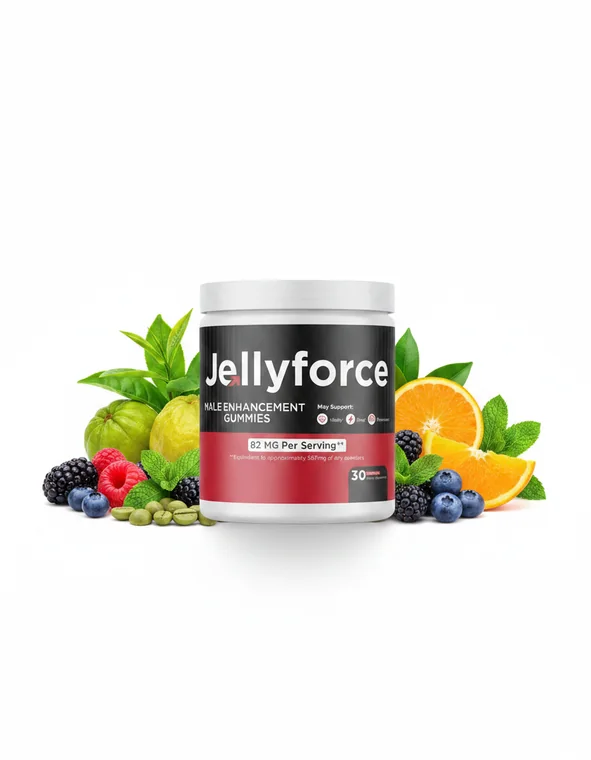
A capsule is a container. Dry powder goes in, the shell closes, and nothing has to taste of anything.
A gummy is food. It has to set, chew and taste sweet, which means sugar syrup, a gelling agent, acid and flavor before an active ingredient is considered.
On this label the base is visible in the other ingredients line: Corn syrup, cane sugar, water, apple pectin, sorbitol liquid, natural flavors, citric acid, sodium citrate dihydrate. Corn syrup and cane sugar come first, which is a ranking by weight.
How much active a gummy can carry
The limit is taste and texture, not volume. Herbal extracts are bitter, and most are grainy. Past a small amount they turn a sweet into something nobody finishes.
That is why this panel reads 82 mg for the whole blend. Nine ingredients share it, and only caffeine is broken out, at 5 mg.
A capsule has no taste to protect. Its ceiling is the shell size, which is why powder products in this category usually print larger numbers per piece.
- 82 mgBlend per gummy
- 3 gAdded sugar per gummy
- 10Calories per gummy
- 1Gummy a day, as directed
3 g of added sugar, and a bottle of them
| Measured on the panel | Per gummy | Per 30-gummy bottle at 1 gummy a day |
|---|---|---|
| Total sugars, all added sugar | 3 g (6% DV) | 90 g |
| Calories | 10 | 300 |
| Total carbohydrate | 3 g (1% DV) | 90 g |
| Sodium | 4 mg (<1%) | 120 mg |
| Proprietary blend | 82 mg | 2,460 mg |
| Caffeine | 5 mg | 150 mg |
The sugar is the row that separates the formats. A capsule version of the same blend would carry none of it.
3 g a day is a small number in isolation. It is still 6% of the daily value taken every day, and it arrives with 82 mg of blend rather than instead of it.
The blend row shows the trade from the other side. A whole bottle of gummies holds about 2.5 grams of blend in total, spread over a month and nine ingredients.
Taste, chewing and finishing the bottle
A supplement only works if it is taken. That is the honest case for gummies, and it is not a small one.
A chewable needs no water and no swallowing. People who gag on capsules, or who keep forgetting a bottle in a cupboard, often keep up with a sweet.
Pros
- No water needed, so it travels and fits any routine
- Easy for anyone who struggles to swallow capsules
- Pleasant taste, which is why bottles get finished
- Pre-measured at one piece, so there is nothing to count
Cons
- Sugar and calories arrive with every piece
- Less active material fits per piece than in a capsule
- Tastes like a sweet, which makes extra pieces tempting
- Softens and fuses above the labeled storage range
The last cons line matters for anyone with children in the house. The label says to keep the bottle out of the reach of children, and a sweet-tasting supplement earns that warning twice over. The directed amount is 1 gummy a day.
Heat, storage and the 59 to 86 degree range
The wrap prints a range: Store at room temperature, 59-86 degrees F (15-30 degrees C). Keep the bottle tightly closed.
Pectin holds a gummy together, and warmth softens it. Once the surface sugar gets tacky, pieces stick to each other and to the bottle wall.
A fused block is not a safety problem by itself. It does make one piece a day hard to measure, which is a real problem for a product whose whole amount is 82 mg.
The label also says not to use the bottle if the seal under the cap is broken or missing. That check comes before the storage question, and the arrival checks page runs through it.
Cost per milligram
Cost per milligram is the fairest way to compare formats, and it takes two numbers: the price of a pack and the amount of active per piece.
Only one of those is available here. The panel gives 82 mg per gummy and 30 gummies per bottle. Pack prices are not published on this site, because they appear on the sales page at checkout.
The method is still worth knowing. Divide the pack price by the total milligrams of active in the pack, not by the number of pieces or days.
Find the active per piece
On this panel that is 82 mg of blend, with 5 mg of it caffeine.
Multiply by the pieces in the pack
One bottle of 30 gummies holds about 2,460 mg of blend.
Divide the checkout price by that figure
The result is a price per milligram, which compares across formats.
Check what the milligrams contain
A cheap milligram of an unsplit nine-way blend is not a bargain.
Step four is where most format comparisons end badly. The pricing page sets out what each pack holds without printing a figure the sales page owns.
Gummy against capsule, side by side
| What you are comparing | Chewable gummy | Capsule or tablet |
|---|---|---|
| Active material per piece | Small. Here, 82 mg of blend | Larger, limited by shell size rather than taste |
| Added sugar | 3 g per piece on this label | None from the format itself |
| Calories | 10 per piece | Negligible |
| Taste masking | Built in, which is the point | Not needed, so bitter material is fine |
| Ease of taking | No water, chewable | Needs water and swallowing |
| Heat tolerance | Softens and fuses above the labeled range | Wider tolerance in a closed bottle |
| Appeal to children | High, which is a risk | Low |
| Reading the label | Same rules apply to both | Same rules apply to both |
The final row is the one sellers of either format tend to skip. Format does not decide label quality. A blend row hides a split just as well inside a capsule.
Who each format suits
A gummy suits you if
Capsules are hard to swallow, routines slip easily, and 3 g of added sugar a day fits your diet without a second thought.
A capsule suits you if
You want the largest amount of active per piece, you track sugar closely, or the bottle will sit somewhere warm.
Neither suits you if
A doctor has not yet looked at the symptom you are shopping for. Erection or drive problems can signal heart disease or diabetes.
For healthy adults 18+. Not for pregnant or nursing women. Read the label. The fit page covers the groups this label rules out, and the side effects page names the real interactions behind the blend.
What the format never changes
- The split inside the blend. Eight of the nine amounts are not published in either format.
- The evidence behind an ingredient. A sweet coating adds nothing to a study.
- The need for a doctor when a symptom could be circulatory.
- The fact that no research covers this finished formula.
Format is a delivery decision. It changes how easy a supplement is to take, how much can fit and what else comes along with it. It does not change what the ingredients do.
For the printed panel behind every figure here, read the Supplement Facts page. For the daily routine, read how to use it.
Gummies and capsules: the questions buyers ask
Do gummies work as well as capsules?
That depends on what is inside them, not on the shape. A gummy carrying 82 mg and a capsule carrying a gram of the same material are not comparable products.
Why do gummies hold less than capsules?
Because the sugar syrup and pectin that make a gummy chewable take up most of the piece. Adding more powder makes it gritty and bitter, so the formula caps itself long before a capsule would.
How much sugar is in one gummy here?
3 g of total sugars, all of it added sugar, which the panel marks as 6% of the daily value. The other ingredients list corn syrup and cane sugar first.
Does the sugar matter at one gummy a day?
It is small next to a soft drink and it is not nothing. Over one 30-gummy bottle it is 90 g of added sugar and about 300 calories. Anyone watching blood sugar should count it.
Can gummies melt?
Yes. Heat softens pectin, so gummies fuse into a block. Store at room temperature, 59-86 degrees F (15-30 degrees C). Keep the bottle tightly closed. A hot car or a windowsill is enough to spoil the texture, and the label range exists for that reason.
Are gummies more expensive per milligram?
Usually, because the sweetened base is most of the weight. This site cannot show the arithmetic, because pack prices are not published here and appear on the sales page at checkout.
Which format suits someone who forgets doses?
A gummy, in most cases. It needs no water, tastes like a sweet and sits in the routine more easily. That advantage disappears if the sugar is a problem.
Does a gummy label tell you less?
Not by format. It tells you less here because of the blend row. The panel prints 82 mg for nine ingredients and breaks out only the 5 mg of caffeine.
The order desk
Buy Jelly Force through this desk
Four pack sizes, 30 gummies to a bottle. The order page carries the current prices and every order is covered for 60 days. Need to ask something first? +1 (302) 200-3480.

Keep reading
Jelly Force Supplement Facts
The whole printed panel: calories, sugar, sodium, the 82 mg blend and the distributor block.
Read →RoutineHow to Use Jelly Force
The suggested use line as printed, what one gummy a day means over a bottle, and the parts the label leaves open.
Read →GuideReading a proprietary blend
One printed total, nine names, and the four things label order still tells a careful reader.
Read →